
Capture the failure. Replay the fix.
Obel CLI is a local-first developer tool that captures broken software projects into replayable failure capsules — preserving the exact context of a command, build, or crash so it can be replayed, inspected, explained, and eventually fixed.
On This Page
01 — What Obel does
What Obel does
Obel wraps a command, watches it run, and captures the failure when it exits unsuccessfully. The result is a local folder called a failure capsule.
A capsule is designed to preserve the evidence around a broken command: what ran, what printed, how it exited, which project it came from, and what environment it happened inside.
The first principle is simple: debugging context should not disappear when the terminal scrolls away.
02 — Command surface
Command surface
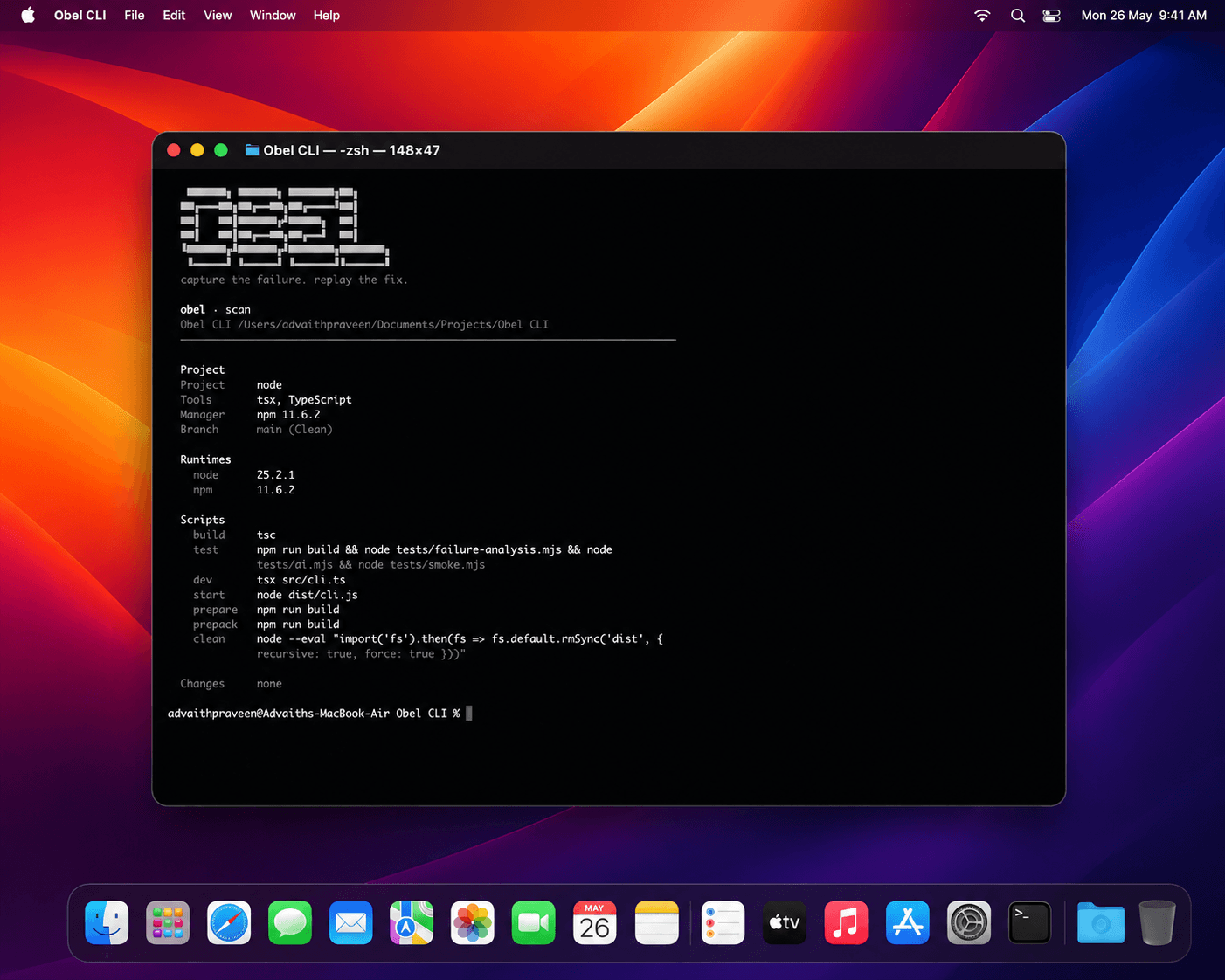
The CLI should stay small enough to remember. These commands define the current product shape:
- obel scan
- obel capture <command...>
- obel replay <capsule-path>
- obel explain <capsule-path>
03 — Failure capsules
Failure capsules
A failure capsule is the core Obel object. It is local-first, inspectable, and structured so humans and tools can both read it.
Known capsule structure:
- .obel/capsules/<slug>/
- capsule.json
- stdout.log
- stderr.log
- report.md
04 — Captured context
Captured context
Obel captures enough context to explain and replay a failure without turning the user’s machine into a surveillance surface.
- command
- stdout
- stderr
- exit code
- duration
- project metadata
- package manager
- git state
- runtime versions
- platform info
- secret-redacted environment keys
- generated report
05 — Privacy model
Privacy model
Obel is local-first by default. Capsules are stored on the developer’s machine, and environment data should be secret-redacted before it becomes part of a report.
The tool should prefer explicit user action over background collection. No account, hosted service, or surprise upload should be required for the CLI workflow.
06 — Roadmap
Roadmap
Obel should not remain just a CLI. The long-term direction is a local-first failure intelligence system: Sentry-style debugging, but self-hosted, capsule-based, and without surprise billing.
The strongest next step is an Obel Dashboard where failures can be viewed, searched, replayed, assigned, explained, and fixed.
- self-hosted Obel dashboard
- capsule viewer
- team triage dashboard
- AI-assisted explanation
- AI-assisted project fixing
- custom LLM repair workflows
- replay comparison
- smarter reports
- stronger project detection
- CI integration & GitHub Action
- open failure capsule standard